
The real transformation at Ignite this year wasn’t announced by “Microsoft” at all. It came from Ryan Roslansky, CEO of LinkedIn, during a moment that almost slipped past the audience. Buried in the keynote, delivered almost casually, was the introduction of the Microsoft IQ . It wasn’t flashy. It wasn’t positioned as a headline. And yet, it will likely become one of the most important architectural shifts Microsoft has made since the launch of Copilot itself. This is crazy!
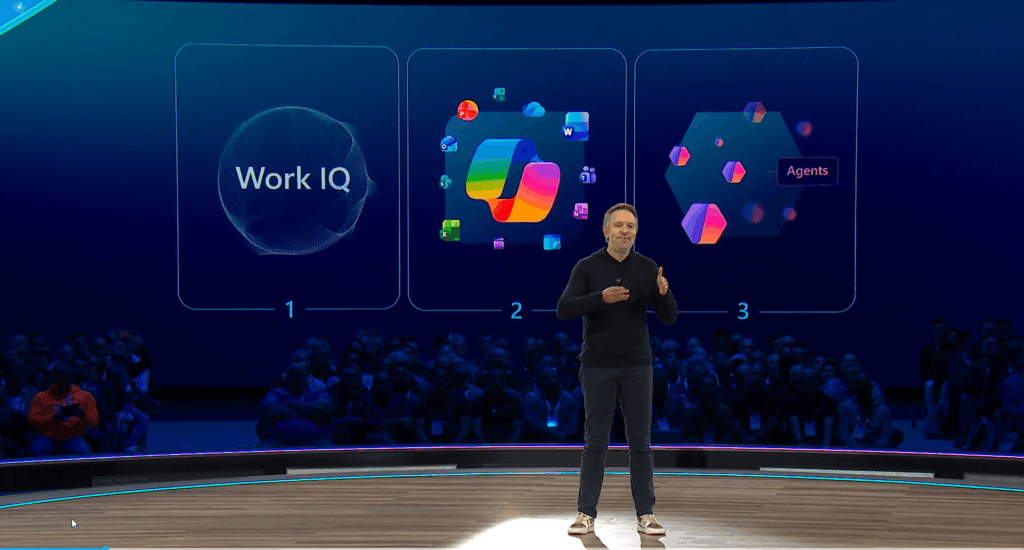
For a couple of years, Copilot has been impressive. It could draft emails, summarize meetings, rewrite documents, analyze content, and automate tasks (for many, those capabilities have already lost a bit of appeal). BUT it was never truly aware of how your organization works. It didn’t understand your relationships or data relationships. It didn’t recognize your patterns. It didn’t see your workflows or your processes. It wasn’t aware of your business semantics. It lived inside each app, moment to moment, with a knowledge graph that admittedly had major gaps with inference.
Microsoft IQ (Work, Fabric, and Foundry IQ) changes this. Work IQ brings intelligence that is persistent, contextual, and grounded in how your organization operates. And when Work IQ pairs with Fabric IQ and Foundry IQ, Microsoft creates something entirely new: a multilayered intelligence stack capable of powering enterprise-grade agents wall to wall.
Let’s explore this impact together.
The Architecture Before Work IQ: Copilot in a Bubble
To understand why Work IQ is such a big deal, you have to understand what Copilot was working with before it existed. Microsoft did an incredible job making Copilot feel intelligent, but under the hood, the architecture was actually very simple. It worked, but it had real limitations, especially for organizations trying to scale AI or build enterprise-grade agent ecosystems. The bottom line was:
Copilot Only Saw What Was Right in Front of It.
Before Work IQ, each Copilot lived entirely inside its host app:
- Word Copilot saw the document
- Outlook Copilot saw the email thread
- Teams Copilot saw the meeting or chat
- PowerPoint Copilot saw the slides
Copilot saw the world through a keyhole. The experience felt intelligent, but the intelligence was scoped to the window you were currently working in. That meant if you asked Word to write a summary based on the meeting you had earlier that day, it didn’t really know what happened unless you dragged that context in manually. Copilot didn’t have cross-app awareness for the most part. See Figure 1 below.
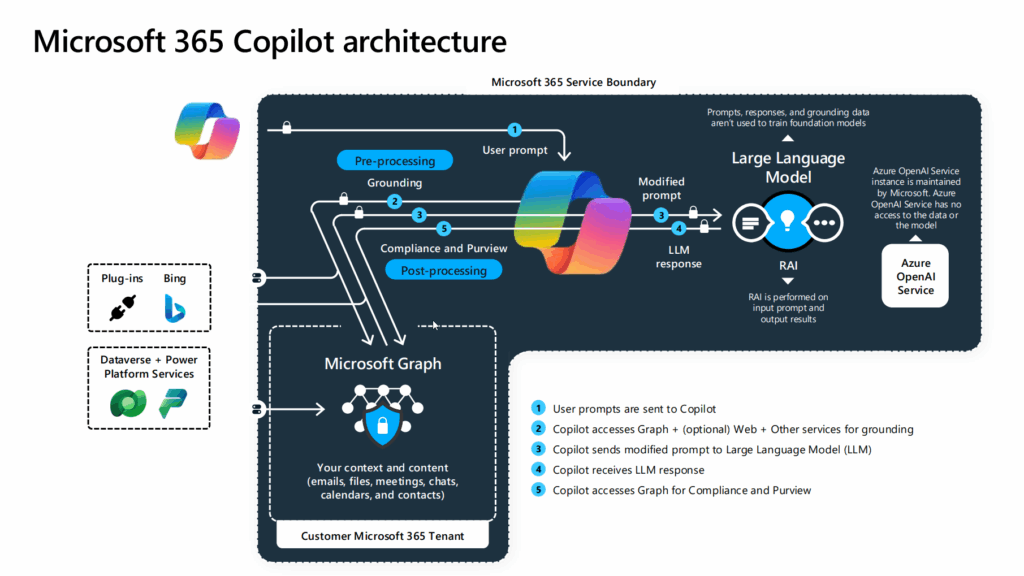
Youve seen the above 1,000 times, but let’s simplify with Figure 2 below. Every Copilot action followed the same pattern:
- Read the prompt
- Query Microsoft Graph
- Run a relevance ranking
- Pull in connectors (if configured!)
- Ground the response
- Call the model
- Return the output
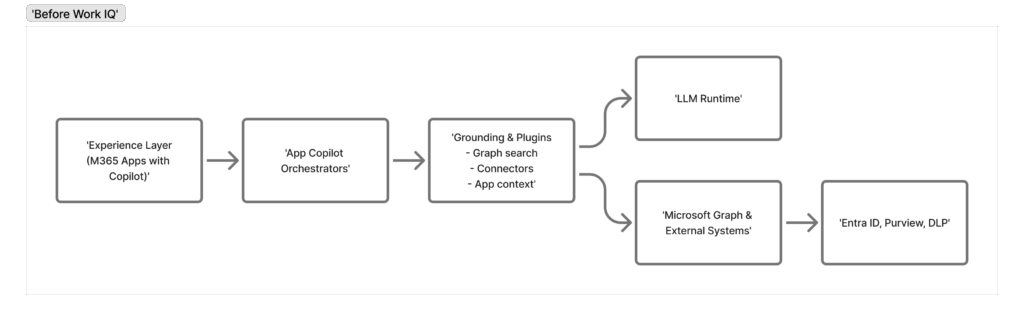
Copilot’s entire intelligence loop lived inside a bubble. Every prompt kicked off the same isolated process, completely unaware of anything that came before it. There was no lasting memory. No continuity from one task to the next. No understanding of your role, your habits, your priorities, or the workflow you were in the middle of.
Copilot rebuilt its world from scratch every single time.
And as soon as it delivered the response, the entire context evaporated. Whatever it learned during that moment existed only for that moment. Then it was gone. Session amnesia. Sort of like me, as I can’t remember what I did 2-hours ago.
This is why Copilot often felt reactive instead of proactive. It could answer the question you asked, but it couldn’t anticipate the one you really meant. It couldn’t understand where you were headed. It couldn’t connect the dots between your meetings, your documents, your tasks, and your goals. It lived in a single moment, inside a single app, inside a single interaction. This gap in Copilot’s architecture wasn’t a small inconvenience. It became one of the biggest unspoken reasons organizations drifted toward third-party AI tools, even when Copilot was already available, licensed, and approved. People rarely leave a platform because they prefer a different logo. They leave because the tool doesn’t feel like it understands them.
And that was the issue. FULL STOP
So users did what users always do.
They went looking for tools understood who they were.
They turned to tools like:
- ChatGPT
- Gemini
- Gemini Enterprise
- Claude
- Glean
- Notion AI
- Perplexity
It wasn’t disloyalty to Microsoft or Copilot. It was survival.
When a tool doesn’t live in your workflow, people find one that does.
The problem wasn’t that Copilot lacked capabilities, as all of the tools above have some lacking. It was that it lacked presence. It wasn’t participating in the workday. It wasn’t weaving itself into the flow of work. It wasn’t as profoundly said at Microsoft Ignite “AI in the flow of human ambition”.
And that matters more than we usually admit.
Because once employees get comfortable with external AI tools that feel cohesive and continuous, it becomes extremely difficult to pull them back into the company’s approved platform. The genie is out of the bottle. Adoption challenges become political, not technical. AI sprawl becomes a governance risk. Shadow AI takes root. And IT ends up playing cleanup instead of strategy. I’ve seen this happen first-hand, and with so many organizations.
This is why Work IQ is such a critical evolution. It doesn’t introduce new buttons or new features. It solves the foundational problem that pushed people away in the first place.
It gives Copilot continuity. It gives Copilot presence. It gives Copilot awareness. And with that, it gives organizations a real path to bringing AI work back inside their trusted ecosystem (in another article I will discuss how I built our Copilot practice and what you can do to make it work this time around)
The Architecture After Work IQ: Look at the Big Brains on Copilot
Work IQ doesn’t simply upgrade the existing Copilot pipeline. It introduces an entirely new layer of intelligence between the app experience and the data. With Work IQ, Copilot stops rebuilding the world every time you ask a question. It starts carrying context. It starts connecting signals. It starts reasoning over the flow of work, not just the content of a single document or email. See Figure 3 below.
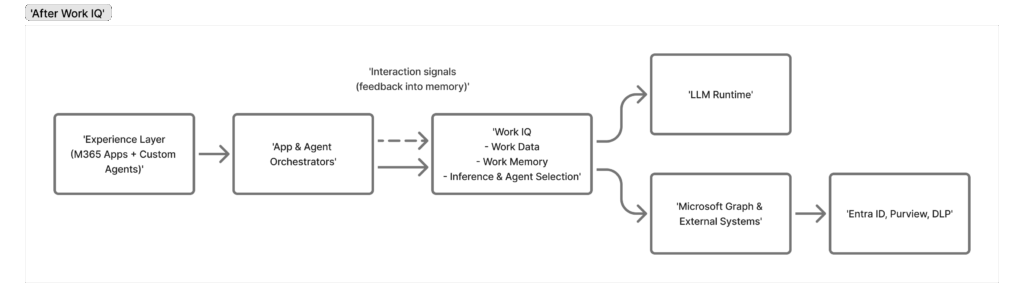
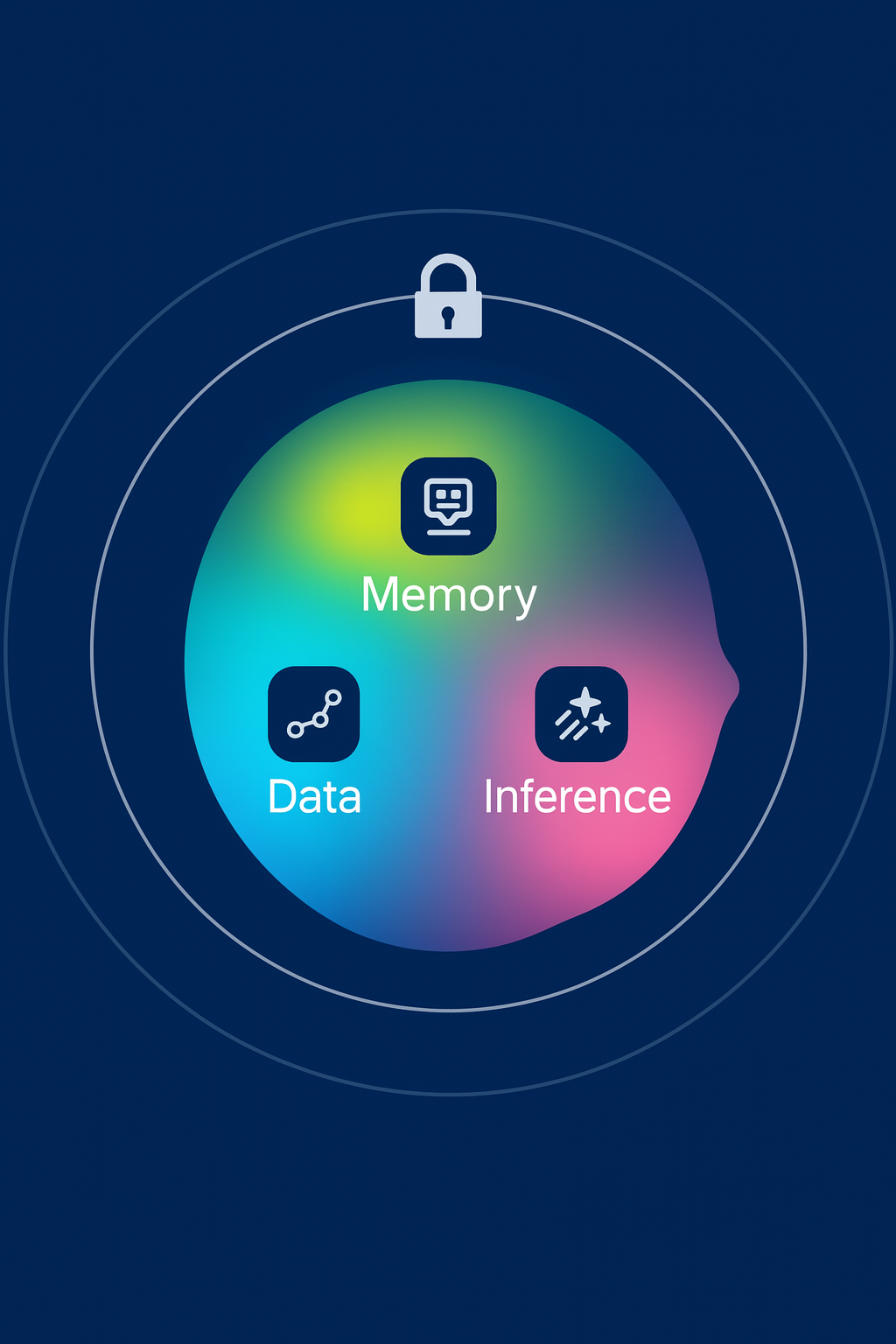
Work IQ is built on three core components: Work Data, Work Memory, and Work Inference.
Work Data goes beyond files and messages. It captures patterns, relationships, recency signals, and the context that defines modern work, something traditional grounding methods simply can’t see. Work Memory adds continuity across apps and sessions, and Work Inference ties it all together by interpreting intent, connecting signals, and predicting what should happen next. See Figure 4 below.
This gives rise to solving for some major issues and frustrations. Table 1 below showcases just a few capabilities that are now possible. I have already started to witness some of these scenarios, and the results are massive!
| Work Data | Work Memory | Work Inference |
|---|---|---|
| A meeting is tied to the deck that was shared. | Carry preferences across apps | Predict next steps |
| An email thread is tied to the customer discussed. | Recall recent activity | Select the right agent |
| A document is tied to the decisions made in Teams. | Understand the user’s role and responsibilities | Identify relevant grounding sources |
| A project isn’t static. It is alive. | Recognize ongoing projects | Understand organizational patterns |
| Track patterns in behavior and workflow | Link together related artifacts | |
| Maintain continuity across sessions | Build plans and recommendations, not just responses |
This is a major shift:
Before Work IQ
Organizations building custom agents had to create:
- Their own context gathering
- Their own memory simulation
- Their own RAG pipeline
- Their own grounding logic
- Their own relationship mapping
- Their own workflow interpretation
Work IQ
A cohesive system
- Context packages
- Organizational signals
- Role and responsibility mappings
- Recency indicators
- Behavioral patterns
- Cross-app continuity
You no longer need to engineer the “what, why, and how” of work. Work IQ gives you that layer automagically.
Work IQ is Only One Layer of Microsoft IQ
Work IQ gives Copilot a real sense of the work happening across an organization, but it’s only one part of the larger intelligence system Microsoft is building. To see the full picture, we have to zoom out and look at how Work IQ connects with Fabric IQ and Foundry IQ.
Work IQ, Fabric IQ, and Foundry IQ are not three separate features.
They are three layers in a single reference architecture, each responsible for a different dimension of intelligence. When a user asks Copilot a question, all three layers activate in parallel, contribute their piece of the puzzle, and combine into one complete grounding package before the model is ever called.
Copilot no longer relies on a single source of truth. It now relies on a coordinated intelligence fabric.
Here’s how the architecture actually works (in theory). Figure 5 below:
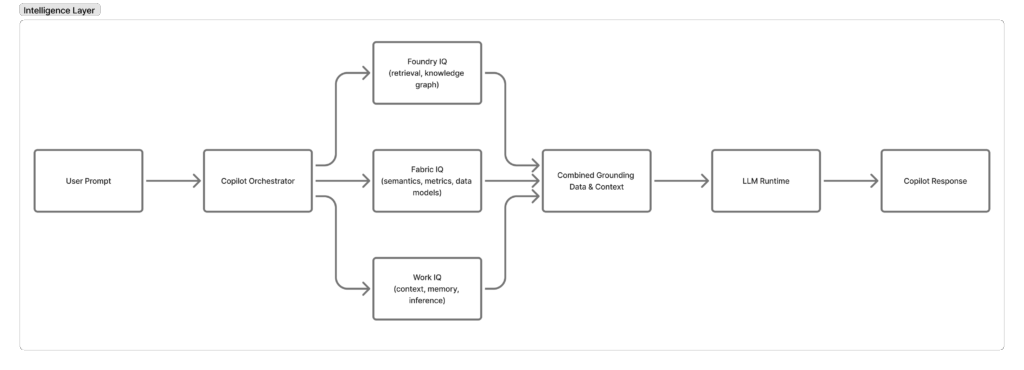
Work IQ, Fabric IQ, and Foundry IQ all kick in whenever you ask Copilot to do something. You do not see them, but they are always working in the background. Think of them as three parts of one system that each understand a different side of your work.
Work IQ is the part that understands you and the people around you. It knows your role, what you have been working on recently, who you are meeting with, and the general context of your day. It gives Copilot the awareness that a real teammate would have. Fabric IQ is the part that understands your business data. It knows your metrics, your definitions, your data models, and how everything fits together. It helps Copilot speak the same language the business speaks. Foundry IQ is the part that understands your knowledge across the organization. It pulls from files, wikis, websites, knowledge bases, and other sources so Copilot has actual information to work with.
For additional reading material Michael Morrison breaks down the origins and integration beautifully in the following article: Ontologies what?
When you ask Copilot for something, all three layers run together. Work IQ gives the context, Fabric IQ brings the meaning, and Foundry IQ brings the knowledge. Copilot blends it into one understanding before the model ever starts generating anything. This is what makes the new architecture feel different. Copilot is no longer pulling from a single place or stuck inside one app. It is looking at the full picture, which is why it finally feels like it understands the work you are actually doing.
What Is Still Unclear
There are still important questions that do not have public answers yet. Work IQ uses signals from emails, meetings, chats, documents, and recent activity, but the exact scope of what signals feed into Work IQ is not fully spelled out. It is also unclear how much tenants will be able to tune or narrow that signal set. What does the security layer look like here? If we are going to remember more, then we inevitably have more to protect.
Memory retention rules are not fully documented. Some parts of Copilot allow users to view or delete memory, but the deeper administrative controls, retention policies, and audit surfaces are not clear yet. What will the the controls look like in Agent 365? Fabric IQ gives organizations a semantic layer, but there is not yet guidance on how it should be governed at scale. Questions remain around version management, domain ownership, quality assurance, and how it aligns with existing Power BI semantic models. Foundry IQ gives you broad retrieval across many knowledge sources, but we still do not know what the full governance story will look like once it expands beyond knowledge bases and common file repositories.
What I Expect Next
The IQ stack brings in more intelligence, but it also brings in more surface area. If Copilot is now pulling from richer signals across Microsoft 365, Fabric, and Foundry, the natural next move for most organizations will be one thing: More control.
And this is where Agent 365 comes into the picture. Agent 365 was introduced at Ignite, and while the announcement was brief, the intent was clear. It is shaping up to be the master control center for enterprise agents and IMO innovation across the stack. The platforms will build and shape the agents, but Agent 365 is designed to govern them. It will be the place where organizations review activity, understand data usage, monitor behavior, and enforce rules across the entire AI ecosystem (even Power Platform Admin Center if my hunch is correct)
That said, it is also fair to call out what we still do not know. Work IQ is not fully documented yet, and it is hard to say how much tuning or scoping control organizations will have over the signals it uses. Fabric IQ and Foundry IQ are still early. The governance surfaces are emerging, but not complete. And many of the deeper controls we will eventually need have not been announced.
So the right posture right now is to stay curious and prepare for more maturity in the coming months. This is going to be a big part of the ecoverse whether YOU want it or not. We will want guardrails. We will want visibility. We will want tuning options. And we will want stronger alignment with Purview, Microsoft 365 governance, Defender, and role based access controls as the IQ stack becomes more central to how work happens.
The direction is clear. The architecture is forming. But the full control plane is still evolving, and I expect Agent 365 to play a major role in giving organizations the confidence and oversight they need as this shifts from preview to fully operational.
Excited to see this one grow!
Continue Reading:
- Microsoft Fabric IQ Overview
https://learn.microsoft.com/en-us/fabric/iq/overview - Azure AI Foundry Knowledge Retrieval
https://learn.microsoft.com/en-us/azure/ai-foundry/agents/how-to/tools/knowledge-retrieval - Microsoft Ignite Announcement: AI Agents and Copilot
https://news.microsoft.com/en-hk/2025/11/19/microsoft-ignite-2025-empowering-the-frontier-firm-with-ai-agents-and-copilot - Microsoft Fabric Documentation
https://learn.microsoft.com/en-us/fabric/ - Azure AI Foundry Documentation
https://learn.microsoft.com/en-us/azure/ai-foundry/ - Copilot Studio Documentation
https://learn.microsoft.com/en-us/microsoft-copilot-studio/